The conservation of the Breviary

One year after the dissolution of Geraardsbergen Abbey (1796), the buildings were bought up by one Emmanuel Piers, a Ghent businessman and supporter of the French regime. He had the medieval abbey entirely demolished and sold off left over stone as construction material. The precise fate of the rich library at St Adrian’s Abbey is unknown. The four-volume Breviary is still in evidence in the final inventory compiled in 1796 by the French commissioner. Thereafter the trail goes cold for several decades.

However, seventy years later the Breviary and eight other manuscripts from Geraardsbergen Abbey reappear in the auction catalogue for the collection held by the priest Charles Welvaert of Gentbrugge. This collector, born in Zomergem in 1797, had been appointed as pastor to Gentbrugge in 1832 and died there in 1866. He was a celebrated bibliophile in Ghent circles and attended important public auctions of books. The Welvaert collection was not a sizeable one and consisted of early printed deluxe editions and prints.

The precise fate of the rich library at St Adrian’s Abbey is unknown.

However, seventy years later the Breviary and eight other manuscripts from Geraardsbergen Abbey reappear in the auction catalogue for the collection held by the priest Charles Welvaert of Gentbrugge. This collector, born in Zomergem in 1797, had been appointed as pastor to Gentbrugge in 1832 and died there in 1866. He was a celebrated bibliophile in Ghent circles and attended important public auctions of books. The Welvaert collection was not a sizeable one and consisted of early printed deluxe editions and prints. The nine manuscripts from Geraardsbergen Abbey appear to form a cluster, directly connected to dispersion of the collection at the start of the French Revolution. One possible hypothesis is that Charles Welvaert’s elder brother, Christophorus Bernardus, who was vicar of Geraardsbergen between 1815 and 1820, gained possession of a part of the collection hidden away at that location. He moved to Ypres when he was appointed dean of St Martin’s Church there in 1835 and, after his death in 1864, his brother Charles came into possession of the small collection of manuscripts from St Adrian’s Abbey.

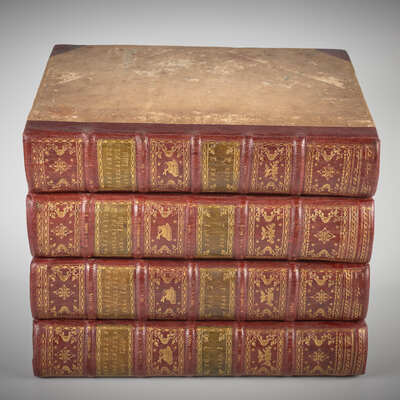
The Ghent auction catalogue of 1866 describes the Geraardsbergen Breviary as follows: ‘14. Breviarum Manuscriptum, anno 1200. 4 beaux vol. in-fol, demi-rel. maroq. rouge’ (four fine volumes in folio, half-bound in red Morocco leather). These bindings still encase the four volumes of the Breviary. The original heavy fifteenth-century bindings were utterly lost amid the historical convulsions of the late eighteenth century and the French Revolution.

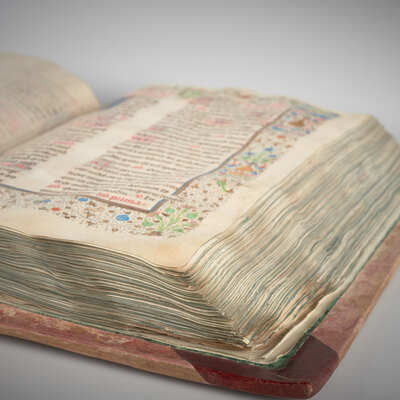
Painted edge

(ms. F°/3/3)

Stamped gilding on the spine of the binding

The present bindings that encase each volume are thought to date from the early nineteenth century. The red Morocco leather spine has been embellished with two figurative imprints bearing Christian iconography; one depicts the Lamb of God from the Book of Revelation bearing a cross and seated on a book from which seven seals are hanging, while the other shows a fruit basket with roses from which a flying dove is snatching grapes. The spine has been further decorated with small stamped imprints in the form of palmettes, stars, garlands and stylised flowers. The gold tooling  is in Empire style employing a continuous or beaded line and interlacing.

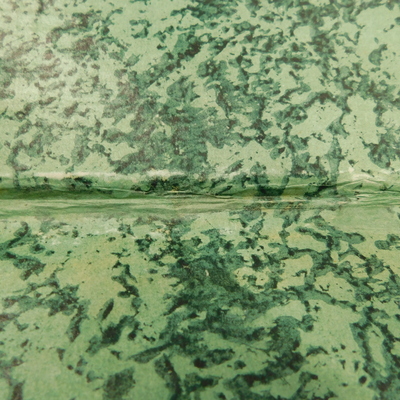
Detail from the flyleaves in green marbled paper

The rest of the binding is rather restrained. The  covers in board have been clad in a decorative pink starch marbled paper. Bright green marbled paper has been used for the front and back flyleaves. The manuscripts’ edges have been trimmed and dyed blue. The binding is in the style of the Parisian bookbinder Joseph Thouvenin (1791–1834). Half-bound leather bindings were particularly popular in the first half of the nineteenth century. The title given on the spine’s green label – ‘Breviarium manuscriptum. Anno 1200’ – is erroneous as it dates the book two hundred and fifty years earlier. Mistakes of this sort were not uncommon given that the scientific study of miniatures was all but non-existent in the early nineteenth century.

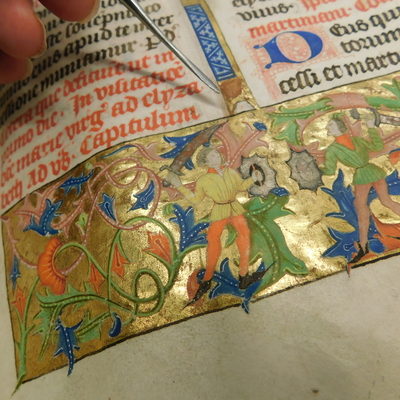
Contemporary book restorers set to work in the manner of archaeologists when conserving and restoring medieval manuscripts. Instead of ruins, their worksite is the manuscript, and every fragment and every instance of damage is carefully recorded and photographed.

The hand of time has definitely left its mark in the present case; during research it became clear that the four volumes of the Breviary had been kept for some time in a very damp environment, sometimes causing the red ink to become powdery and leave marks behind on the facing folio. Gold leaf applied to red Armenian bole has flaked away slightly, as has the black ink (iron gall ink).

After microscopic analysis, the Breviary’s vellum was gently cleaned using small wads of cotton wool and gums, undulating folios were smoothed, folded corners were unfolded again. When cleaning the folios, restorers came across insects, blades of grass, seeds, feathers and pieces of paper, traces of former users at Geraardsbergen Abbey. All items were carefully preserved and recorded. The original colours of the miniatures were still fresh and exceptionally well preserved. At times there were smudges created by a reader having wetted their finger, which is not so remarkable given that the miniatures were painted using a water-based medium.

The bindings – more or less two hundred years old – were also in urgent need of preservative restoration and were meticulously consolidated, reinforced and supplemented. They are now able to afford optimum protection to the four volumes of the celebrated Breviary.

Lieve Watteeuw

Bibliography

L. Watteeuw (2020). 'Het restaureren van middeleeuwse documenten in België in de loop van de 20ste eeuw. Nieuwe technieken - nefaste gevolgen.' In: BRK-APROA, (108-112). Presented at the Gerestaureerd met de beste bedoelingen. Postprints van de 10de editie van de internationale studiedagen, BRK-APROA, 2019., Brussel, KBR, 21 Nov 2019-22 Nov 2019. ISBN: 9789048638833.


Catalogue de la bibliothèque de feu Mr Charles Welvaert, curé à Gentbrugge, dont la vente publique aura lieu à Gand, par le ministère et sous-direction de Ferd. Verhulst, le Mardi 11 Décembre 1866 et jour suivant, le matin à 9 1/2 et l’après-midi à 2 1/2 heures, en la Salle St. Georges rue Haut-Port, Ghent, 1866, p. 13, lot 14.


L. Schokkaert, Biografisch repertorium van de priesters van het Bisdom Gent 1802–1997 (2 vol.), Leuven, 1997, p. 608.