Volume 3

The third volume was made in Ghent. The decoration is attributed to the Master of the Geraardsbergen Breviary and the Master of Gerard Brilis. In the colophon, on fol. 205v, is mentioned that Wilhelmus de Predio finished the volume on December 23, 1449. It contains antiphons and collecta, Suffrages, Office of the Dead, prayers, calendar, psalter, Temporale (from the Trinity to the 25th Sunday after Pentecost) and Offices. Today, the four volumes are preserved in the Abbey of Maredsous, Denée. Discover the third volume through the extensive description below and have a look at every detail in our online viewer.

Master of Gerard Brilis, Three warriors (Abisaï, Sobothaï and Benaja) carry a cistern with water to Bethlehem, detail from the margin, medallion

(ms. F°/3/3, fol. 25r)

Breviary, use of the abbey of Saint Adrian, Geraardsbergen (third part of a breviary in four parts: F°/3/1-4) (“Breviary of Geraardsbergen”)

Latin

Probably Ghent, soon after 23 December 1449

Master of the Geraardsbergen Breviary (Mets group) (I); Master of Gerard Brilis (II)

Parchment, II (paper) + 205 ff. + II (paper), 355 × 255 mm. 1/8 (ff. 1-8), 2/10 (ff. 9-18), 3/6 (ff. 19-24), 4-17/8 (ff. 25-136), 18/4 (ff. 137-140), 19-25/8 (ff. 141-196), 26/10-1 (ff. 197-205).

Ruling in red ink. Calendar: 6 columns, 34 lines, 12 + 7 + 12 + 7 + 6 + 120 × 242 mm; text: 2 columns, 30 lines, 235/240 × 160/163 mm.

Textualis, perhaps by two hands: (I) ff. 1-24v°, 141-205v°; (II) ff. 25-140v°.
Copied by Wilhelmus de Predio on 23 December 1449 (see Remarks: colophon on f. 205v). Rubrics in red ink.

21 historiated initials, 3 to 9 lines. Decorated initials, 2 to 4 lines. Filigree initials, 1 to 2 lines, blue with red filigree or red with blue filigree, alternating, two types: (I) in accordance with the type of volumes 1 and 2, with oblique tendrils in the margin; (II) vertical tendrils, adhered to the text column. Plain initials (18v).

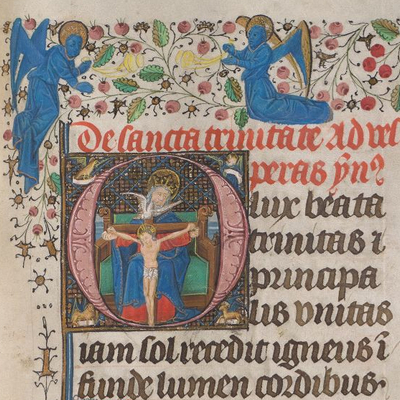
Master of Gerard Brilis, Holy Trinity with the symbols of the Evangelists, initial

(ms. F°/3/3, fol. 131r)

Border decoration, two types: (I, type Mets) airy net of filigree leaves with gilded vine leaves, sprinkled with vegetal motifs and multicoloured acanthus, ordered symmetrically around the axis parallel to the border of the folio. Figures inhabit the inside of the acanthus scrolls, presented against a checkered background. Other figures, birds, animals, and monsters inhabit the margins; (II, type Brilis) a dense net of filigreed foliage with vine leaves and gilded ciliate bezants.

The margins of f. 25 are punctuated with historiated medallions with narrative amplifications; between the medallions: ample multicoloured foliage, with souple windings, filigreed scrolls carrying roses or strawberries, with leaves in partly green and gold. Simplified versions of the two types around the historiated initials or the decorated initials of 2 to 4 lines: (I) quires 1-2, 19-22; (II) quires 4-18.

Master of the Geraardsbergen Breviary, Mourner, detail from the margin

(ms.F°/3/3, fol. 13r)

Pen drawings of astonishing diversity and originality in the quires of type I (1-2, 19-26): animals (real or fantastic), hybrids, scenes from the world upside down, human figures of all social classes (from shepherd to monk, pilgrim, knight, or courtesan), biblical scenes, folklore figures. These motifs are not derived from playing cards.

Pen drawing, Disguised as a Monk, Reynaert the Fox preaching to the Animals, detail from the margin

(ms. F°/3/3, fol. 168v)

Pen drawing, Hunting scene, detail from the margin

(ms. F°/3/3, fol. 3r)

Line fillers decorated in blue and red, in the quires of type II (4-18); absent in the quires of type I, except for f. 18v: simple pen strokes in red ink. – Modern binding (18th century), quarter binding in red morocco, tooling in gold. On the back, the inscription BREVIARIUM MANUSCRIPTUM ANNO 1200 TOM 2 PARS 1.


Calendar: Abbey of Saint Adrian, Geraardsbergen


Office of the Dead: variant of the use of Cluny (with, at lesson 8, the responsory Domine non secundum (not listed by OTTOSEN) instead of Domine secundum actum). See OTTOSEN, Responsories, p. 285-295.

Quire, text, illumination

Quire

1/8, 2/10


3/6


4-17/8, 18/4


19-25/8, 26/10-1

Text

1: End of an Office of Our Lady (incomplete)


1-1v°: Antiphones and collecta of the Virgin Mary and Saint Adrian


1v°-2v°: Office of Our Lady: matins


2v°-3v°: Collectes


3v°-5: Psalmi familiares cum precibus


5-10v°: Suffrages post laudes et vesperas: with, amongst others, Adrian (5), Nicolas and Bernard (9)


10v°-13: Antiphones and collecta of the Virgin Mary (In veneratione gloriose virginis Marie)


13-17v°: Office of the Dead


17v°-18: Prayers for daily services (super exeuntes de coquina, super intrantes ad serviendum…)


18v°: Hymn Eterne rerum conditor


19-24v°: Calendar


25-108: Ferial Psalter (Psalm 1, 20 (21), 26 (27), 32 (33), 38 (39), 45 (46), 52 (53), 59 (60), 68 (69), 73 (74), 79 (80), 95 (96), 97 (98), 101 (102), 109 (110))


108-121v°: Collecta to recite at terce, sext and noon


121v°130v°: Canticles


131-140: Hymns. To note, the ones to Saint-Adrian (135v°-136)


140v°: Blank, ruled


141-205v°: Temporale, from the Trinity to the 25th Sunday after Pentecost [Office of the Trinity]


[Feast of Corpus Christi (In nova sollepnitate corporis Domini)]


[Office of the first Sunday in August]


Illumination

13: Office of the Dead, in initial D; margins: Three mourners (I)


25: David at prayer, in initial B; medallions in the margin: David carrying the head of Goliath, David against the Philistines, three warriors (Abisaï, Sobothaï and Benaja) carry a cistern with water to Bethlehem (II)


37v°: David at prayer, in initial D (II)


40v°: David at prayer, in initial D (II)


44v°: David as a musician, in initial E (II)


49v°: King David, with scepter and crown, in initial D (II)


54: David at prayer, in initial D (II)


57v°: Soldiers, in initial D (II)


61: David at prayer, in initial D (II)


65: David at prayer, immerged in water, in initial S (II)


69v°: David at prayer, in initial U (II)


74v°: David at prayer, in initial Q (II)


84: David at prayer, in initial C (II)


85: David as a musician, faced to an altar, in initial C (II)


86v°: David at prayer, with stretched arms, in initial D (II)


95: God the Father and Christ on his right side, in initial D (II)


108: Abbot Nicaise du Frasne at prayer, in initial A (II)


131: Trinity with the symbols of the Evangelists, in initial O; border decoration: angel musicians, thurifer angels (II)


141: Trinity (Throne of Grace), with the Holy Spirit in the form of an angel, in initial G; bas-de-page: hunting scenes (I)


145v°: Elevation of the Host, in initial S; margin: battle between a hybrid and a monster, peacock carries a belt with the inscription "Disce pati lite" (I)


160v°: King Salomon enthroned, in initial P (I)

Remarks: on f. 205v: “Scriptum per me Wilhelmum de Predio anno Domini 1449° in vigilia vigilie Nativitatis Domine (23 December 1449)”.

Dominique Vanwijnsberghe

Bibliography

T. DELFORGE, Le bréviaire de Saint-Adrien de Grammont, in Scriptorium, 12, 1958, p. 102-104.


L.M.J. DELAISSÉ, Les techniques du livre dans le bréviaire bénédictin de Grammont, in Scriptorium, 12, 1958, p. 104-107 .


ID., La miniature flamande. Le mécénat de Philippe le Bon (exh. cat.), Brussels, 1959, n° 38, p. 42-43.


E. DHANENS, Le scriptorium des hiéronymites de Gand, in Scriptorium, 23, 1969, p. 361-379 (here, p. 374-375).


M. SMEYERS, Bijzondere randversieringen in een 15de-eeuws brevier, in Spiegel Historiael, 4, 1969, p. 72-78.


A.H. VAN BUREN en S. EDMUNDS, Playing Cards and Manuscripts: Some Widely Disseminated Fifteenth-Century Model Sheets, in The Art Bulletin, 56, 1974, p. 12-30 (here, p. 18, 20, 23, 26, 27 n. 14, 28 n. 16, 29 and n. 24).


Catalogue entry by A. DE SCHRYVER, in Gent. Duizend Jaar Kunst en Cultuur, 2. Boekdrukkunst. Boekbanden. Borduurkunst. Edelsmeedkunst. Miniatuurkunst (exh. cat.), Ghent, 1975, n° 588, p. 358-359.


G. VAN BOCKSTAELE, Abbaye de Saint-Adrien, à Grammont, in Monasticon Belge, 7. Province de Flandre Orientale, 2, Liège, 1977, p. 53-128 (here, p. 55, 65, 70).


Catalogue entry by G. WINDEY, in Aspecten van het monastiek leven in de Nederlanden (exh. cat.), Ghent, 1980, n° 495, p. 118-120, ill. p. 119, 165.


O. PÄCHT, U. JENNI en D. THOSS, Flämische Schule I (Österreichische Akademie der Wissenschaften, philosophisch-historische Klasse, Denkschriften, 160 = Veröffentlichungen der Kommission für Schrift- und Buchwesen des Mittelalters, Reihe 1. Die illuminierten Handschriften und Inkunabeln der Österreichischen Nationalbibliothek, 6), 1. Textband, Vienna, 1983, p. 32, 53, 58.


E. WOLF, Das Bild in der spätmittelalterlichen Buchmalerei. Das Sachsenheim-Gebetbuch im Werk Lievin van Lathems, Hildesheim/Zürich/New York, 1996, p. 261-266.


R.F. POSWICK, Le Bréviaire bénédictin de Grammont (Geraardsbergen), in Le livre et l’estampe, 43, 1997, n° 148, p. 21-112.


L. KNAPEN, Catalogue des manuscrits de l’abbaye de Maredsous (Bibliotheca Manuscripta Monasteriorum Belgii, 1), Turnhout, 1997, p. 8-12.


G.T. CLARK, Made in Flanders. The Master of the Ghent Privileges and Manuscript Painting in the Southern Netherlands in the Time of Philip the Good (Ars nova. Studies in Late Medieval and Renaissance Northern Painting and Illumination), Turnhout, 2000, p. 114-115, ill. 69.


D. VANWIJNSBERGHE, « De fin or et d’azur ». Les commanditaires de livres et le métier de l’enluminure à Tournai à la fin du Moyen Âge (Corpus of Illuminated Manuscripts, 10), Leuven, Peeters, 2001, p. 15 n. 92, fig. 84-85.


ID., Catalogue entry in Medieval Mastery. Book Illumination from Charlemagne to Charles the Bold 800-1475, Leuven/Turnhout, 2002, n° 75, p. 288-293.


K. VAN DER HOEK, Antonis Rogiersz. uten Broec. Een verluchter uit Utrecht, werkzaam in de Zuidelijke en de Noordelijke Nederlanden, in Oud Holland, 117, 2004, p. 119-136 (here, p. 121, 134 n. 6) .


J.H. MARROW, The Master of Gerard Brilis, in Quand la peinture était dans les livres. Mélanges en l’honneur de François Avril, Turnhout/Paris, 2007, p. 168-191 (here, p. 170-172, 185-186 n. 6-12).


D. VANWIJNSBERGHE, « Cher et vénéré Maître ». L’adresse enluminée envoyée par ses collègues belges à Léopold Delisle, après l’annonce de sa mise à la retraite forcée (1905), in Léopold Delisle. Actes du Colloque de Cerisy-la-Salle (8-10 octobre 2004), eds. F. VIELLARD en G. DESIRE DIT GOSSET, Saint-Lô, 2007, p. 71, 73.


ID., « Ung bon ouvrier nommé Marquet Caussin ». Peinture et enluminure en Hainaut avant Simon Marmion (Contribution to l’Étude des Primitifs flamands, 12), Brussels, 2013, p. 44 n. 23, 46 n. 70, 356, fig. 44, 445.


D. VANWIJNSBERGHE en E. VERROKEN, « A l’Escu de France ». Guillebert de Mets et la peinture de livres à Gand à l’époque de Jan van Eyck (1410-1450) (Scientia artis, 13), Brussels, 2017, p. 252, 415 n. 67, 415 n. 68, 419-427, 429, 433, 434, 437, 479 n. 25.