Volume 1

The first volume was produced in Ghent by the end of 1448. The decoration is connected to entourage of the Master of Margaret of Schorisse (Mets group) and to the Hand A of Geraardsbergen Breviary. Contents: Diverse prayers, calendar, psalter and Temporale, from the first Sunday of Advent to the vigil of the Epiphany (January 5). Today, the four volumes are preserved in the Abbey of Maredsous, Denée. Discover the first volume through the extensive description below and have a look at every detail in our online viewer.

Hand A of the Geraardsbergen Breviary, Tree of Jesse, initial

(ms. F°/3/1, fol. 141r)

Breviary, use of the Abbey of Saint Adrian, Geraardsbergen (first volume of a breviary in four parts: F°/3/1-4) (“Breviary of Geraardsbergen”)

Latin

Probably Ghent, late 1448?

Entourage of the Master of Margaret of Schorisse (Mets group) (I); Hand A of the Geraardsbergen Breviary (II)

Parchment, II (paper) + 190 ff. + II (paper), 340 x 230/235 mm, 1-3/8 (ff. 1-24), 4/6 (ff. 25-30), 5-17/8 (ff. 31-134), 18/6 (ff. 135-140), 19-24/8 (ff. 141-188), 25/2 (ff. 189-190).

Ruling in red ink. Calendar: 6 columns, 34 lines, 12 + 7 + 12 + 7 + 6 + 120 x 235 mm; text: 2 columns, 30 lines, 230/238 x 164/165 mm (in the calendar: additional saints on f. 4: 31 lines)

Gothic textualis, by the hand of Wilhelmus de Predio. Rubrics in red ink.


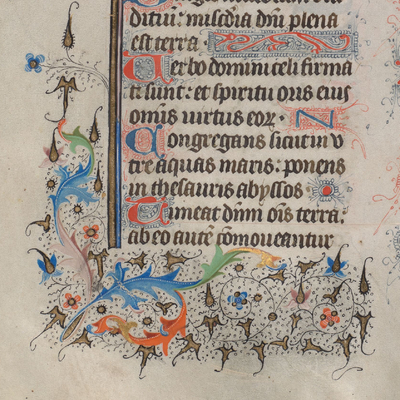
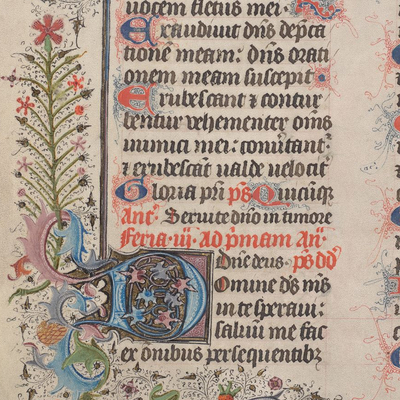
4 historiated initials of 6 to 10 lines. Decorated initials of 3 to 5 lines, two types: (I, principal hand) interlace of vine leaves, highlighted with white filigree, funnel shaped on a golden ground; (II, alternated with I on the pages with type III margins) on ff. 35v and 41v, acanthus scrolls, and dragons painted tone on tone. Blue filigree initials with red filigree or red with blue filigree, 1 to 2 lines, throughout the manuscript, with tendrils in the margin that run diagonal (DELAISSÉ 1958, p. 105). Champ initials of 4 lines (ff. 48v, 141, 163).

Entourage of the Master of Margaret of Schorisse (Mets Group), David at Prayer, initial

(ms. F°/3/1, fol. 31r)

Border decoration type I (Mets group), A four-legged hybrid playing the horn, detail from the margin

(ms. F°/3/1, fol. 31r)

Border decoration type I (Mets group), David and Goliath, detail from the margin

(ms. F°/3/1, fol. 31r)

Border decoration, three types: (I, type Mets, f. 31) in a rectangular frame, with a dense network of filigree with gilded vegetal motifs (hastate leaves, grains, and ciliate bezants) or multicoloured, punctuated, in the corners and in the middle of the right margin motley acanthus. The intercolumn carries foliage in the shape of pistachio shells, which is associated with the Mets group. In the margin: David and Goliath, a peacock, a four-legged hybrid playing the horn, another one on two legs fights an acanthus leaf. A simplified version of these margins decorates f. 48v.

Border decoration type I (Mets group), filigree, detail from the margin

(ms. F°/3/1, fol. 48v)

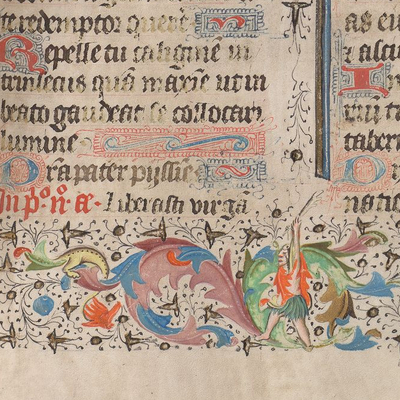
(II, Hand A of the Geraardsbergen Breviary, on four sides on ff. 93v, 141, 163 and a large part of the margins in I and in C) in a rectangular frame, with an airier net of frayed filigree leaves, carrying gilded vegetal motifs (hastate foliage with oblate base and gilded bezants, sometimes triangular) or multicoloured, punctuated, in the corners and in the middle of the margins ligneous acanthus, in more matted tonalities than the ones of type I. Hybrids and animals by the same hand as the historiated scenes, inhabited in the margins – lions, gilded birds standing on their legs (very characteristic), peacocks, griffon (f. 163). The wild man, the deer, and the lion on ff. 71 and 93v are based on playing cards.

Border decoration type II, Wild man, detail from the margin

(ms. F°/3/1, fol. 71r)

(III, on the text pages of quires 5 and 6, ff. 31-36) fusiform, rather raw margins develop outside the rectangular frame, a dense net of filigree foliage is surrounded by sinuous filaments, with nervous tracing, carrying gilded vegetal motifs (hastate foliage, grains, and ciliate bezants, sometimes surrounded by hooks, mounted on sort of springs) or multicoloured (flower heads (campions, thistle…), strawberries and in the intercolumn of f. 37 leaves in the shape of pistachio shells, associated with the Mets group), punctuated acanthus with pale colours (grey, blues and bright greens, old rose). In the exterior margin of f. 32v, two straight bars with red campions and to opposite branches. In the margins: winged dragons and human heads emerge from the acanthus; a hybrid combats a bird (bas de page f. 35v).

Border decoration type III, Bar with red campion, detail from the margin

(ms. F°/3/1, fol. 32v)

Numerous pen drawings, traced by the author of the filigree initials (de Predio?) and perhaps an assistant: repertoire of dragons, hares and dogs, hunting scenes, dragons with characteristic oak leaves, sometimes accompanied with acorns, disseminated throughout the whole manuscript, especially in the quires 3, 5-6, 9, 12, 16-17. The repertoire becomes the most varied from quire 19, with more ambitious motifs and a crude execution, sometimes inspired by playing cards: wild men, lions, birds on ff. 146, 150v°, 153v°, 160, 164, 166v°, 168v°, 180, 184 et 185.


Line fillers decorated, filigreed with geometric motifs, or looped, blue and red. – Modern binding (18th century), quarter binding in red morocco, gold tooling. On the back the inscription in gilded letters BREVIARIUM MANUSCRIPTUM ANNO 1200 TOM 1 PARS 1.

Pen drawing, Wild man playing the lute, detail from the margin

(ms. F°/3/1, fol. 153v)

Pen drawing, Lion, detail from the margin

(ms. F°/3/1, fol. 185r)

Calendar: Abbey of Saint Adrian, Geraardsbergen


Office of the Dead: variant of the use of Cluny (with, at lesson 8, the responsory Domine non secundum (not listed by OTTOSEN) instead of Domine secundum actum). See OTTOSEN, Responsories, p. 285-295.

Quire, text, illumination

Quire

1-3/8


4/6


4-17/8, 18/4


5-24/8, 25/2

Text

1-24v°: Diverse texts: prayers (1-2), fifteen psalms with collecta to recite before matins (2-3), penitential psalms and litanies [Adrian and Judoc are added] (3-4v°), prayers to recite at Easter to Saint Michael (4v-6v), cursus Beatae Mariae (6v-9), little Office of the Blessed Virgin, to noon (9-12), suffrages to the saints to recite after lauds and vespers, with Adrian in first position (12-20), Office of the Dead (20-24), diverse prayers (24-24v°)


25-30v°: Calendar


31-139: Ferial psalter, with canticles (117-129v°) and hymns (129v°-139)


139v°-140v°: Blank, ruled


141-190v°: Temporale, from the first Sunday of Advent to the vigil of the Epiphany (January 5) (ending is missing)


[Nativity]

Illumination

31: David at prayer, in initial B (I, retouched by the Master of Gerard Brilis?)


93v°: David at prayer, in initial D (II)


141: Tree of Jesse, in initial E (II)


163: Nativity, in initial P (II)

Remarks: it is estimated that the realization of each volume took about six months, VAN BUREN and EDMUNDS (1974, p. 29 n. 24) situate the completion of the present volume by the end of the year 1448.

Dominique Vanwijnsberghe

Bibliography

T. DELFORGE, Le bréviaire de Saint-Adrien de Grammont, in Scriptorium, 12, 1958, p. 102-104.


L.M.J. DELAISSÉ, Les techniques du livre dans le bréviaire bénédictin de Grammont, in Scriptorium, 12, 1958, p. 104-107 .


ID., La miniature flamande. Le mécénat de Philippe le Bon (exh. cat.), Brussels, 1959, n° 38, p. 42-43.


E. DHANENS, Le scriptorium des hiéronymites de Gand, in Scriptorium, 23, 1969, p. 361-379 (here, p. 374-375).


M. SMEYERS, Bijzondere randversieringen in een 15de-eeuws brevier, in Spiegel Historiael, 4, 1969, p. 72-78.


A.H. VAN BUREN en S. EDMUNDS, Playing Cards and Manuscripts: Some Widely Disseminated Fifteenth-Century Model Sheets, in The Art Bulletin, 56, 1974, p. 12-30 (here, p. 18, 20, 23, 26, 27 n. 14, 28 n. 16, 29 and n. 24).


Catalogue entry by A. DE SCHRYVER, in Gent. Duizend Jaar Kunst en Cultuur, 2. Boekdrukkunst. Boekbanden. Borduurkunst. Edelsmeedkunst. Miniatuurkunst (exh. cat.), Ghent, 1975, n° 588, p. 358-359.


G. VAN BOCKSTAELE, Abbaye de Saint-Adrien, à Grammont, in Monasticon Belge, 7. Province de Flandre Orientale, 2, Liège, 1977, p. 53-128 (here, p. 55, 65, 70).


Catalogue entry by G. WINDEY, in Aspecten van het monastiek leven in de Nederlanden (exh. cat.), Ghent, 1980, n° 495, p. 118-120, ill. p. 119, 165.


O. PÄCHT, U. JENNI en D. THOSS, Flämische Schule I (Österreichische Akademie der Wissenschaften, philosophisch-historische Klasse, Denkschriften, 160 = Veröffentlichungen der Kommission für Schrift- und Buchwesen des Mittelalters, Reihe 1. Die illuminierten Handschriften und Inkunabeln der Österreichischen Nationalbibliothek, 6), 1. Textband, Vienna, 1983, p. 32, 53, 58.


E. WOLF, Das Bild in der spätmittelalterlichen Buchmalerei. Das Sachsenheim-Gebetbuch im Werk Lievin van Lathems, Hildesheim/Zürich/New York, 1996, p. 261-266.


R.F. POSWICK, Le Bréviaire bénédictin de Grammont (Geraardsbergen), in Le livre et l’estampe, 43, 1997, n° 148, p. 21-112.


L. KNAPEN, Catalogue des manuscrits de l’abbaye de Maredsous (Bibliotheca Manuscripta Monasteriorum Belgii, 1), Turnhout, 1997, p. 8-12.


G.T. CLARK, Made in Flanders. The Master of the Ghent Privileges and Manuscript Painting in the Southern Netherlands in the Time of Philip the Good (Ars nova. Studies in Late Medieval and Renaissance Northern Painting and Illumination), Turnhout, 2000, p. 114-115, ill. 69.


D. VANWIJNSBERGHE, « De fin or et d’azur ». Les commanditaires de livres et le métier de l’enluminure à Tournai à la fin du Moyen Âge (Corpus of Illuminated Manuscripts, 10), Leuven, Peeters, 2001, p. 15 n. 92, fig. 84-85.


ID., Catalogue entry in Medieval Mastery. Book Illumination from Charlemagne to Charles the Bold 800-1475, Leuven/Turnhout, 2002, n° 75, p. 288-293.


K. VAN DER HOEK, Antonis Rogiersz. uten Broec. Een verluchter uit Utrecht, werkzaam in de Zuidelijke en de Noordelijke Nederlanden, in Oud Holland, 117, 2004, p. 119-136 (here, p. 121, 134 n. 6) .


J.H. MARROW, The Master of Gerard Brilis, in Quand la peinture était dans les livres. Mélanges en l’honneur de François Avril, Turnhout/Parijs, 2007, p. 168-191 (here, p. 170-172, 185-186 n. 6-12).


D. VANWIJNSBERGHE, « Cher et vénéré Maître ». L’adresse enluminée envoyée par ses collègues belges à Léopold Delisle, après l’annonce de sa mise à la retraite forcée (1905), in Léopold Delisle. Actes du Colloque de Cerisy-la-Salle (8-10 octobre 2004), eds. F. VIELLARD en G. DESIRE DIT GOSSET, Saint-Lô, 2007, p. 71, 73.


ID., « Ung bon ouvrier nommé Marquet Caussin ». Peinture et enluminure en Hainaut avant Simon Marmion (Contribution to l’Étude des Primitifs flamands, 12), Brussels, 2013, p. 44 n. 23, 46 n. 70, 356, fig. 44, 445.


D. VANWIJNSBERGHE en E. VERROKEN, « A l’Escu de France ». Guillebert de Mets et la peinture de livres à Gand à l’époque de Jan van Eyck (1410-1450) (Scientia artis, 13), Brussels, 2017, p. 252, 415 n. 67, 415 n. 68, 419-427, 429, 433, 434, 437, 479 n. 25.